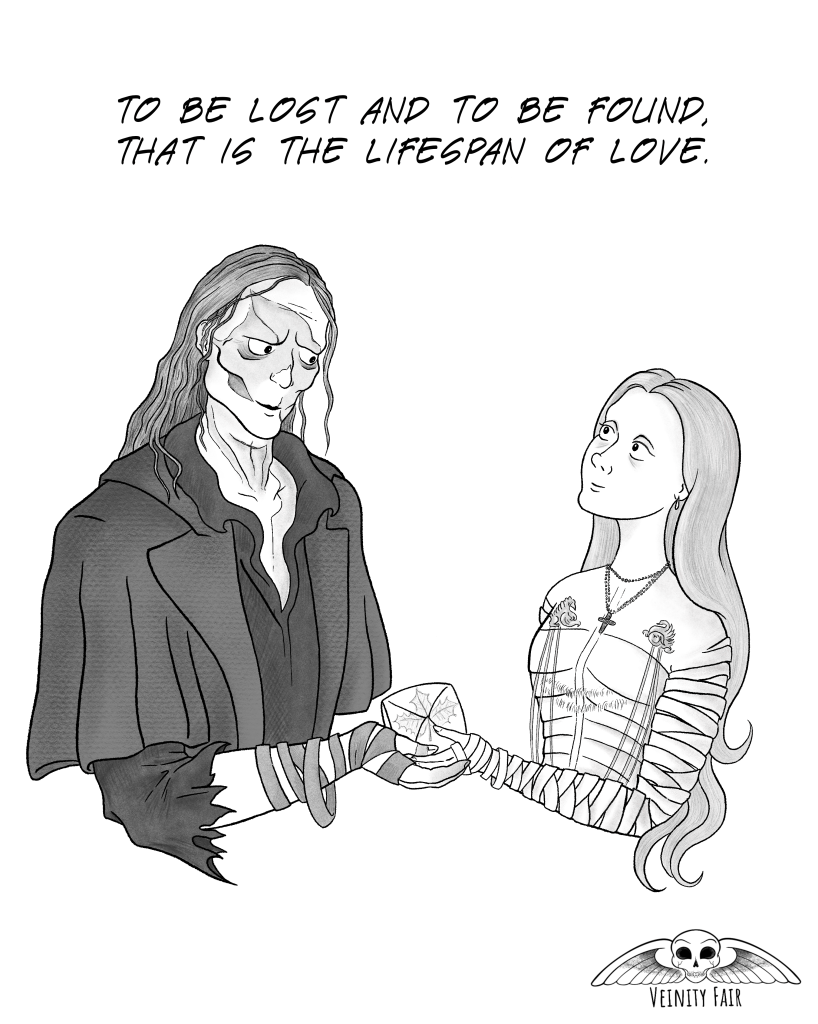
Have you sent any Valentine cards, reels, or gifs yet? Maybe consider a popular Victorian way of sending romantic messages – a puzzle purse. Inspired by the early Japanese art of tatogami, a puzzle purse is a piece of paper folded in such a way as to create a small envelope or box. Inside, one can find a secret message, a picture, or even a small gift.
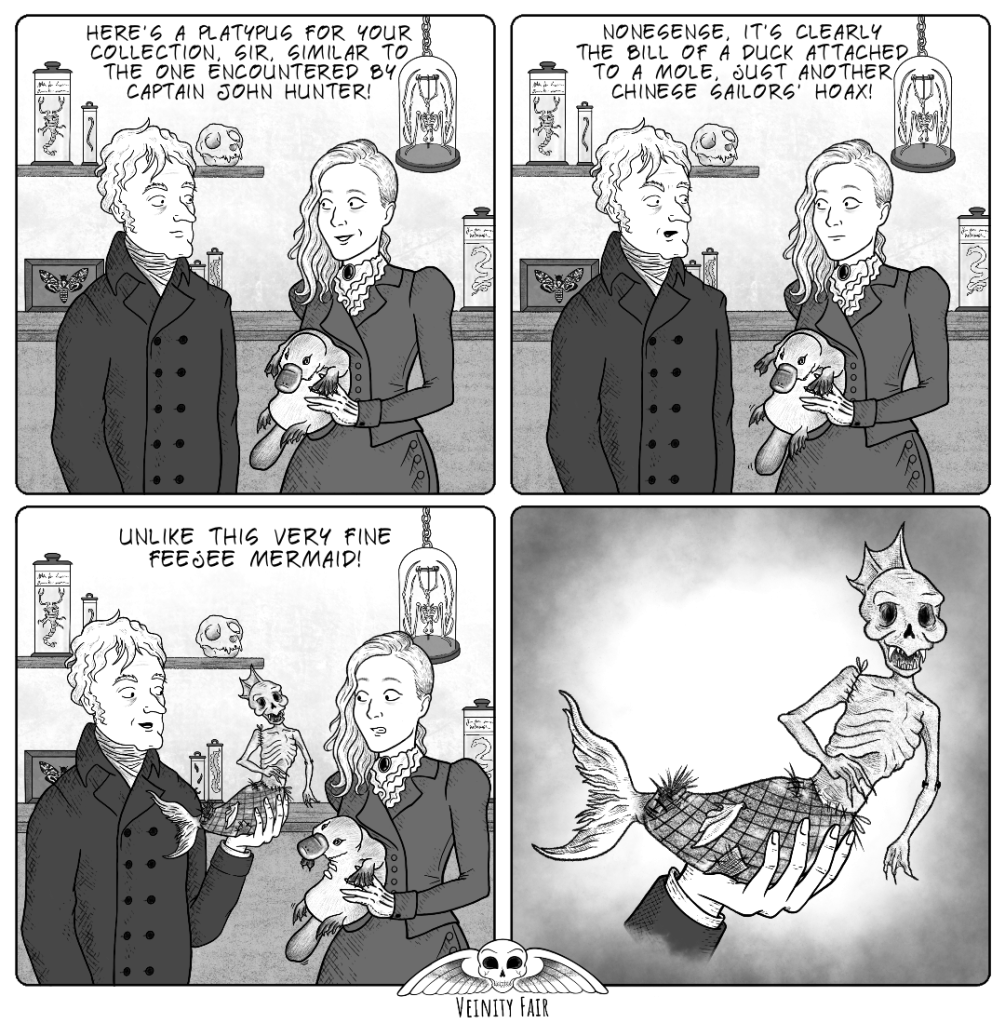
The platypus was a real mystery to the first Europeans who encountered this graceful creature, some even doubted its existence! When Captain John Hunter sent a pelt of the animal to the naturalist George Shaw in 1799, the scientific community was baffled. Shaw named the animal Platypus anatinus, aflatfoot duck, but also expressed his doubts about the authenticity of the bizarre creature, saying that “there might have been practised some arts of deception in its structure.” Other naturalists were equally suspicious that the beast was just a hoax. This was linked to the popularity of fake specimens, such as Feejee mermaids, shown at sideshows.
As the infamous anatomist Robert Knox* explained: “Aware of the monstrous impostures which the artful Chinese had so frequently practised on European adventurers, the scientific felt inclined to class this rare production of nature with eastern mermaids and other works of art.” Knox also had a chance to perform a thorough dissection of a platypus and published a series of articles about its anatomy.
Big thanks to @skull.slinger (IG) for becoming a star adventurer for VF! Together, we’ll bring more stories about real and mythical beasts of the past.
*Yes, that’s the same Robert Knox who bought bodies from Burke and Hare. Expect a lot of stories surrounding resurrectionists this year as well!
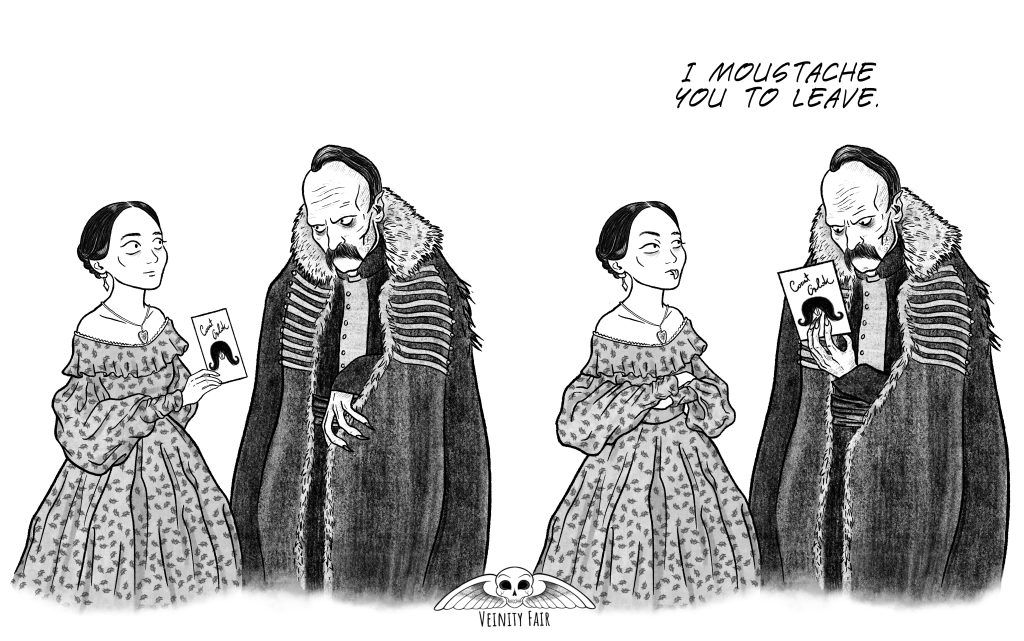
While the Victorians loved sending cute lace-trimmed cards on Valentine’s Day, they didn’t shy away from sending other types of cards to people they wanted to fend off or play a joke on. In such cases, they would send what was known as “vinegar valentines,” which often contained mean poems or caricatures.
One of such cards read:
“To My Valentine ‘Tis a lemon that I hand you and bid you now ‘skidoo,’ Because I love another—there is no chance for you.”
Another séance with Miss Tique, aka @coven_of_skulls !
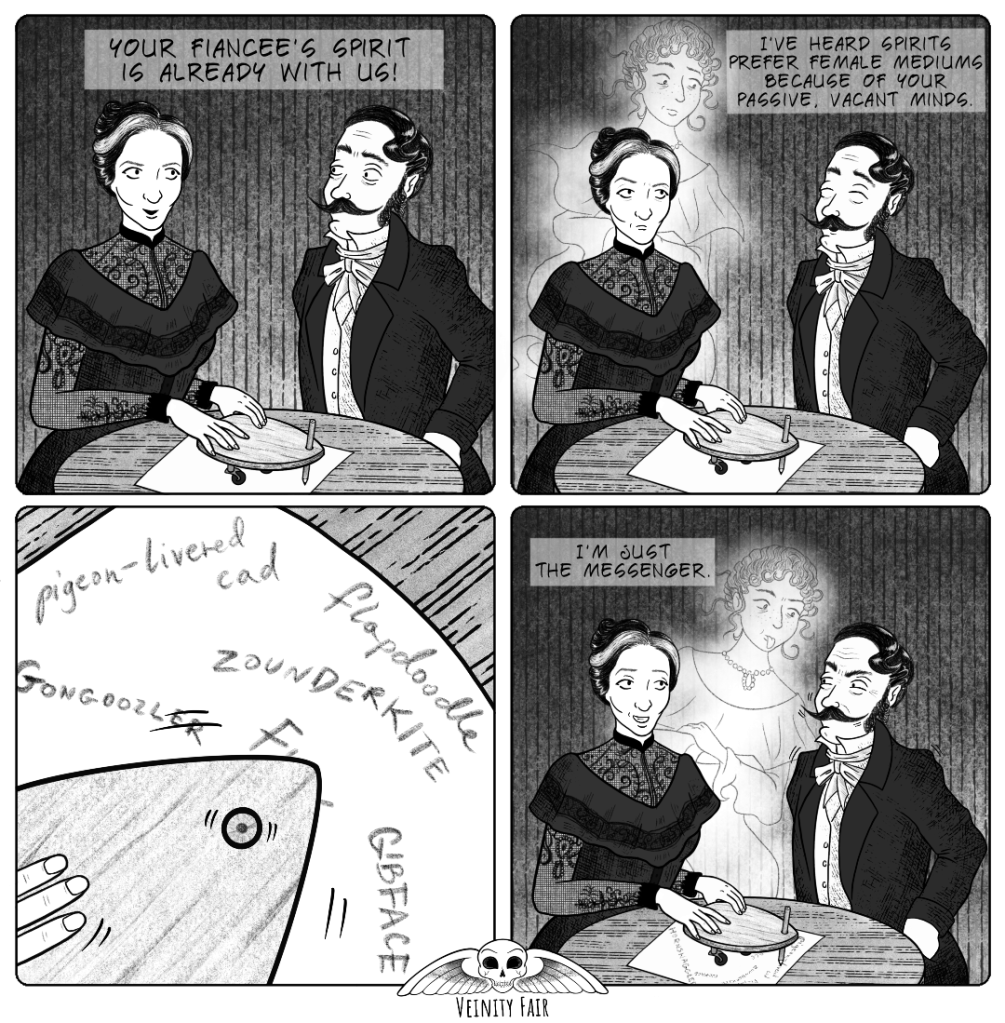
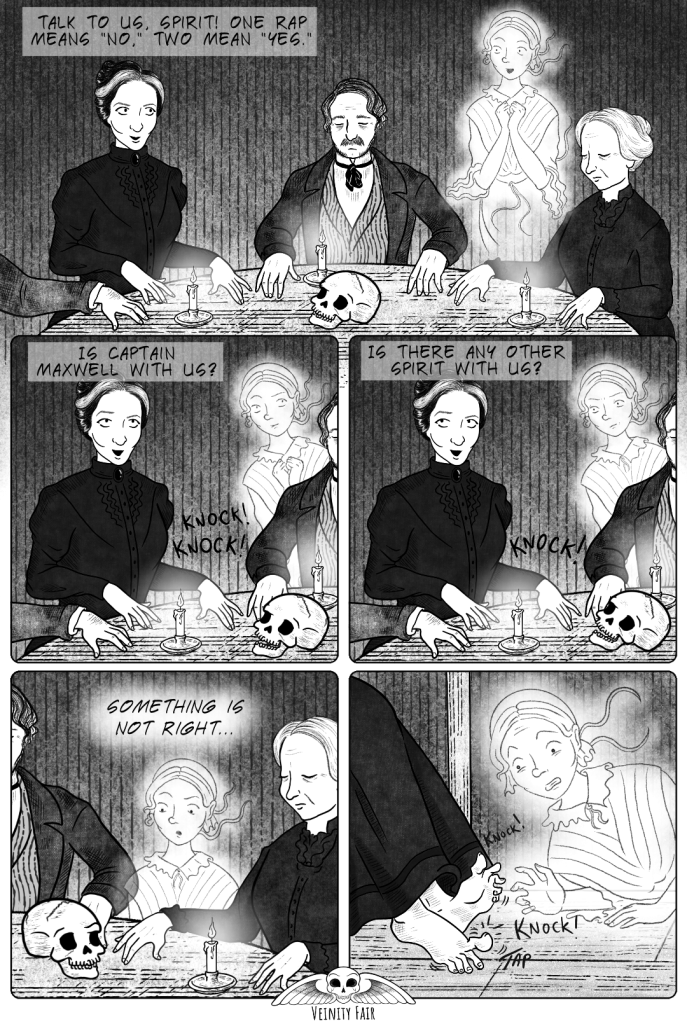
We already know about spirit rapping and how tedious it could be to spell spirits’ messages this way. That’s when automatic writing came along – a much faster way for mediums to channel spirits and convey their messages. At least in theory, since many of the ‘messages from beyond’ were indecipherable scribbles or confusing drawings, especially when the writing was done by a few inspired people at the séance table at once.
Automatic writing could be done just with a regular pen, or with the help of a big stylish planchette with little wheels and a hole to put a pen in. The planchette itself was created during an alphabet-calling session in Paris in 1853. As reported by Allan Kardec, one of the participants of a séance that day channeled the spirits who told them to grab a basket, put it upside down, and put a pencil in it.
As for Miss Tique’s rude guest, it was actually a belief at the time that women made better mediums because they were passive and their minds were ‘vacant,’ thus they could be more easily possessed by spirits. This sexist belief was however embraced and used by female spiritualists in surprising ways, which we’ll explore in future episodes.
It’s time for the first séance with Miss Tique, aka @coven_of_skulls!
Spiritualism was a movement revolving around the belief that it was possible to communicate with the spirits of the dead, especially via séances. Many ideas that originated in that time regarding séances are still present, e.g., in modern movements interested in the paranormal or popular horror and gothic tropes. While there are a few people who could be credited with starting spiritualism, it hadn’t taken off until 1848 when the famous Fox sisters claimed to contact the spirit of a murdered peddler in their house.
To contact the realm of the dead, the Fox sisters held sessions of ‘spirit rappings’ in which a spirit was supposed to spell out answers to questions by raps, taps, and knocking. It often involved calling out the alphabet, letter by letter, which often took a long time. After a few decades of fame, the sisters revealed themselves to be frauds and admitted they produced the sounds by cracking the joints in their toes.
The New York Herald reported, “There stood a black-robed, sharp-faced widow working her big toe and solemnly declaring that it was in this way she created the excitement that has driven so many persons to su*c*de or insanity. One moment it was ludicrous, the next it was weird.”
Veinity Fair is finally back! I missed you guys and I hope you’re ready for some more Victorian trivia and peculiar comics!
Let’s start just where we left off, with topics chosen by a few lucky winners of previous contests and auctions. Today’s comic was inspired by the winner of a local charity auction who took on the role of our early Victorian investigator.
The famous Scotland Yard was formed in 1829, but the Metropolitan Police was far from organized in its infancy. In the beginning, the MP was merely keeping watch on the streets and investigation procedures were just being formed, relying primarily on the so-called “story model” rather than the meticulous practices we’re used to today. Because of that, even crime scenes were often left unattended, with curious crowds peeking in and collecting ‘souvenirs’, as in the below example:
The Examiner 11.12.1831
THE DISEASED APPETITE FOR HORRORS,
“The landlord upon whose premises a murder is committed, is nowadays a made man. The place becomes a show—the neighbourhood as the scene of a fair, The barn in which Maria Martin was murdered by Corder, was sold in toothpicks: the hedge through which the body of Mr. Weare was dragged, was purchased by the inch. Bishop’s house bids fait to go off in tobacco-stoppers and snuffboxes; and the well will be drained—if one lady has not already finished it at a draught —at the rate of a guinea a quart. (…)”
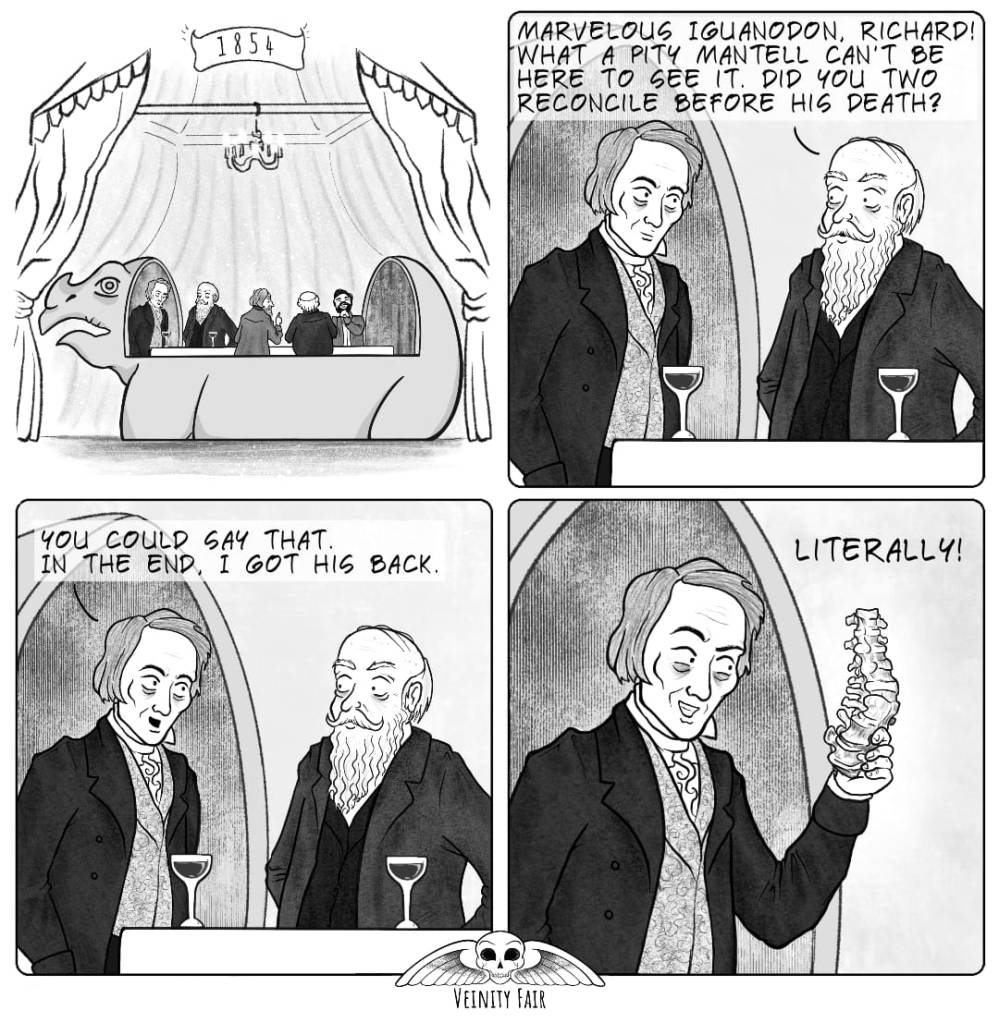
Happy New Year! What did you do for New Year’s Eve? Maybe you spent the night at a fancy dinner party inside a giant concrete Iguanodon, surrounded by prominent scientists? That’s exactly what Richard Owen, a paleontologist famous for coining the word Dinosauria, did on 31 December 1853. The party took place at The Crystal Palace at Sydenham, and the Iguanodon was a part of a larger exhibition of dinosaur models sculpted by Benjamin Waterhouse Hawkins under Owen’s scientific direction. The lavish dinner consisted of eight courses and the whole event was reportedly quite boisterous.
It is not entirely clear whether the scientists spent the night inside of the model itself or rather the mould in which it was made. What is clear though is the fact that Owen’s Iguanodon was not scientifically correct, even given the research available at the time. His rival and the discoverer of the Iguanodon, Gideon Mantell, came to the conclusion that the animal was a reptile of a slender build, not a heavy mammal-like creature Owen believed it to be. Unfortunately for Mantell, Owen was a fame-driven creationist who did not hesitate to steal specimens and research from other scientists, bend data to fit his own agenda, and publish negative reviews of his colleagues’ work behind their back. Plagued by opium addiction he developed after a carriage accident, Mantell was no match for the cunning rival.
On 10 November 1852, Mantell died of an opium overdose, leaving Owen completely free to prepare the Crystal Palace dinosaur sculptures according to his own vision. The post-mortem showed that Mantell had been suffering from severe scoliosis. A section of his spine was removed from the body stored at the Royal College of Surgeons, where no other but Richard Owen was the conservator at the time.
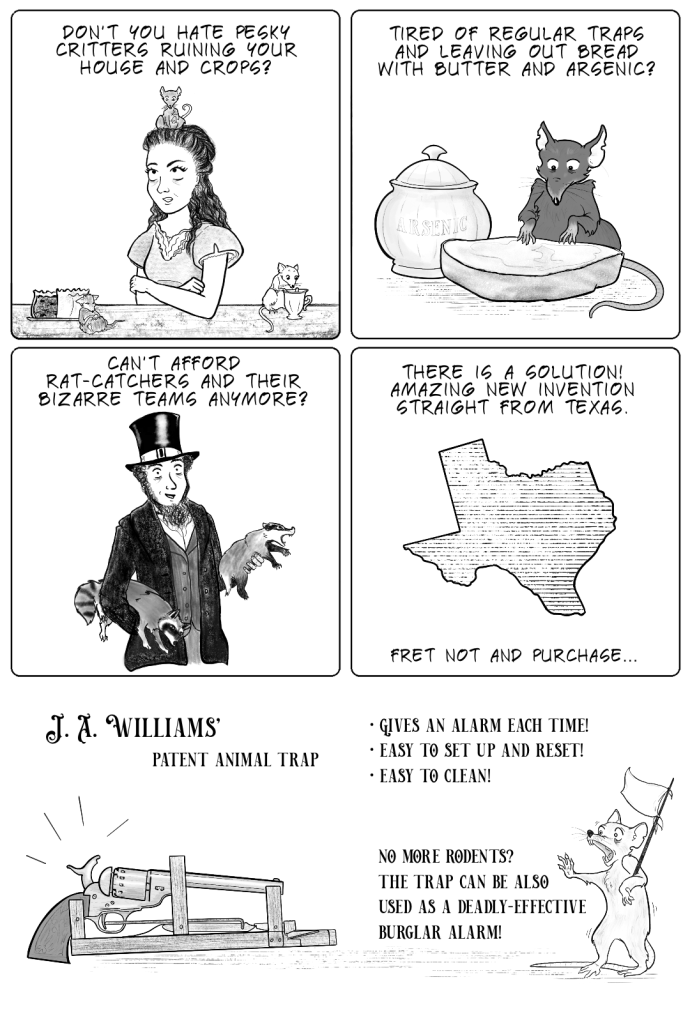
On December 26, 1882, certain James A. Williams was granted a patent for a rather peculiar invention: an animal trap with a spring-loaded firearm. In his patent application, Williams described how the contraption worked:
“[I]t consists in the combination of a suitable frame upon which a revolver or pistol is secured, a treadle which is secured to the front end of this frame, and a suitable spring and levers, by which the firearm is discharged when the animal steps upon the treadle (…) The object of my invention is to provide a means by which animals which burrow in the ground can be destroyed, and which trap will give an alarm each time that it goes off, so that it can be reset.”
Of all the 19th-century ideas on how to deal with pests, this must be one of the most dramatic and over-the-top! The Texan inventor went even further and noted that “[t]his invention may also be used in connection with a door or window, so as to kill any person or thing opening the door or window to which it is attached.”
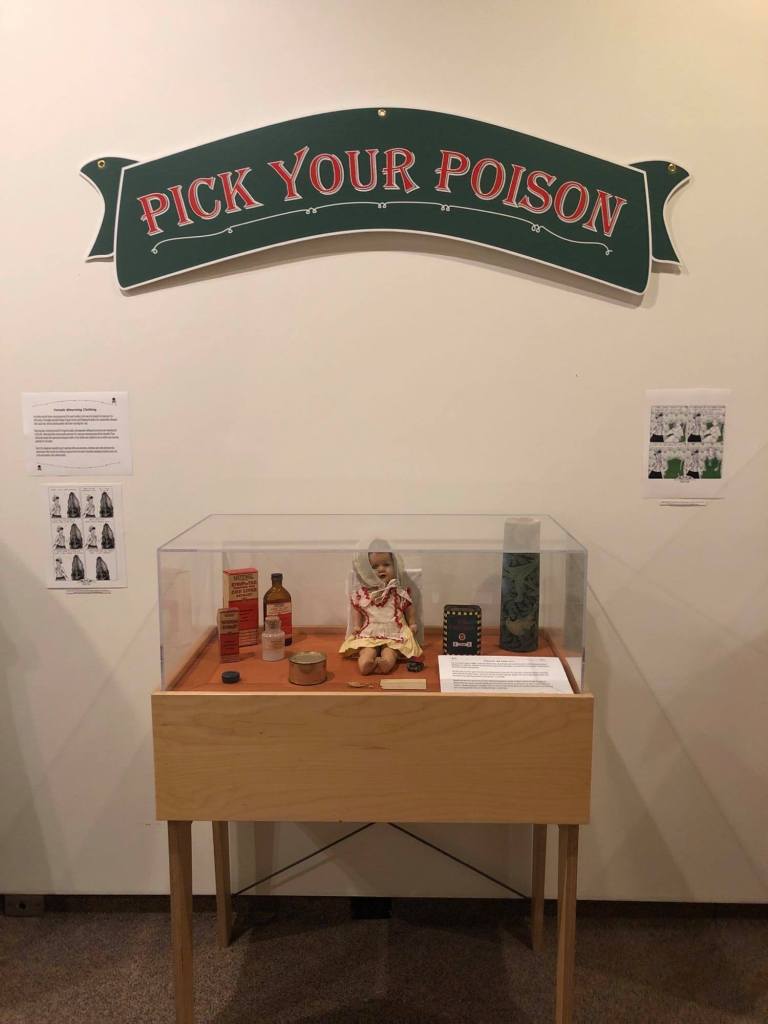
If you happen to be near PEI in Canada, make sure to check out the “Cabinet of Killer Curios” exhibit in the Eptek Art & Culture Centre! The exhibit features deadly & creepy Victorian objects from the collections of the Prince Edward Island Museum & Heritage Foundation, and a little bird told me a few Veinity Fair prints make their appearance as well!
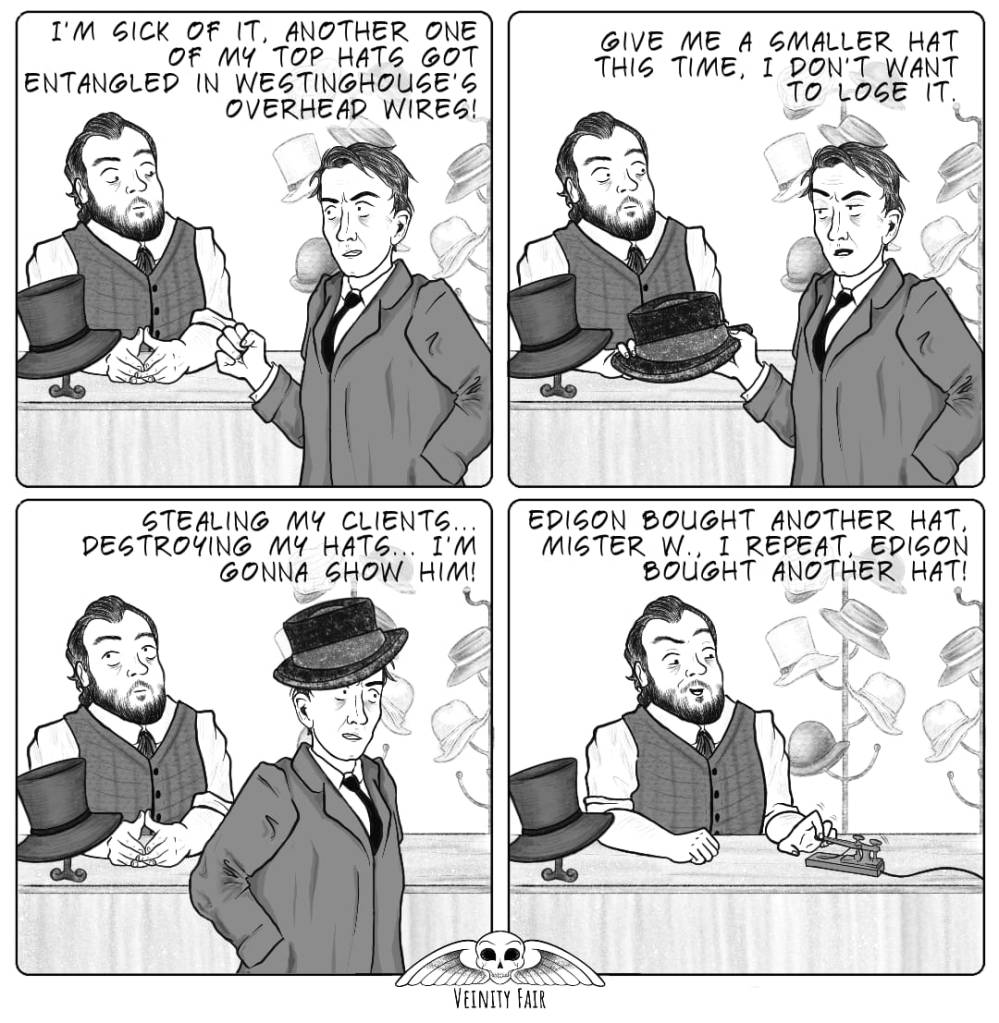
In the early 1880s, an electric light revolution started to take over big American cities. Two electric power transmission systems were introduced: street lamps utilizing high-voltage alternating current (AC) and indoor lighting using low-voltage direct current (DC). The latter was heavily promoted by Thomas Edison, especially when his company was suddenly threatened by new competition: George Westinghouse and his transformers and wire system enabling AC to be used for indoor lighting. The introduction of this new system started the so-called war of the currents, in which the Edison Electric Light Company tried to besmirch Westinghouse’s name and solutions by sparking fear in the public. And while at the time it was true the AC system could be extremely dangerous, the actions taken by some of the people involved were questionable to say the least and involved lying to the press, blackmail, and even killing animals.
This comic was inspired by Andrzej who won the possibility to become one of the characters in a local charity event! If you would also like to become a character in one of the future comics, check out the Anatomist membership level on Veinity Fair Patreon.







 I missed you guys and I hope you’re ready for some more Victorian trivia and peculiar comics!

 What did you do for New Year’s Eve? Maybe you spent the night at a fancy dinner party inside a giant concrete Iguanodon, surrounded by prominent scientists? That’s exactly what Richard Owen, a paleontologist famous for coining the word Dinosauria, did on 31 December 1853. The party took place at The Crystal Palace at Sydenham, and the Iguanodon was a part of a larger exhibition of dinosaur models sculpted by Benjamin Waterhouse Hawkins under Owen’s scientific direction. The lavish dinner consisted of eight courses and the whole event was reportedly quite boisterous.

 If you would also like to become a character in one of the future comics, check out the Anatomist membership level on
  veinityfair.com