Feather Hats

Fashion

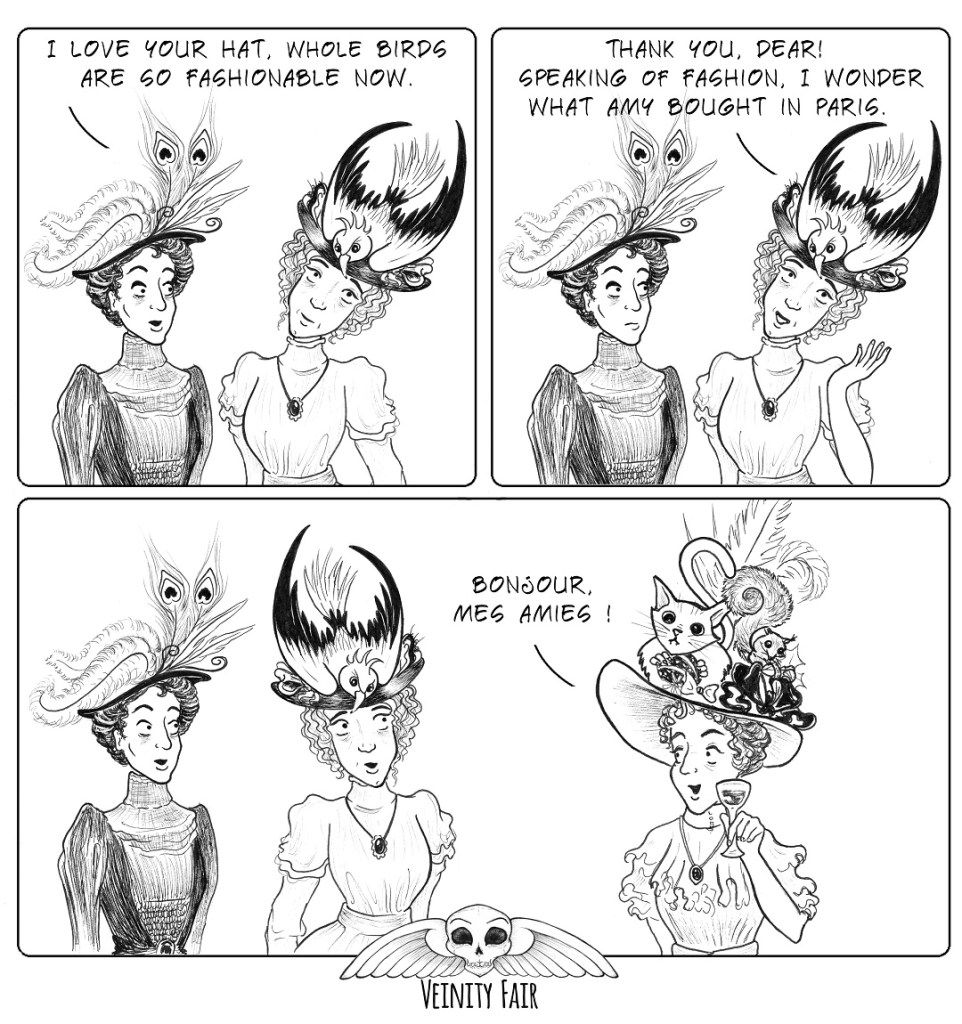
Fashionistas of the late Victorian and Edwardian eras were obsessed with hats. 👒 Particularly with feather hats, adorned with bird feathers, heads, wings, and even whole animals. 🐦🦜 The demand for birds was so high that the millinery industry decimated dozens of species and even drove one of them – the passenger pigeon – into extinction. The last passenger pigeon died in captivity in 1914.

As taxidermy was a popular Victorian pastime, it is said that not only birds, but also other animals such as squirrels, mice, and even cats fell victim of the over-the-top hat fashion. 🐿🐁🐈 In 1883, The New York Times published an article on French fashion stating that “The demand for kittens’ heads has become so important that cat breeding has become a regular business.”

To be honest, I’m not sure if this article wasn’t exaggerating about the French love for kitten hats, so let me know if you’ve come across any other sources on that. 😺

On a brighter note, check out the story of Harriet Hemenway, an activist who pushed for the first federal conservation legislation in the U.S. and greatly limited the feather hat trade.

Everlasting Pill

Drugs, Medicine

Everlasting pill, also known as a perpetual pill, was a popular 19th-century medicine which was supposed to bring balance to the body’s humors by inducing purging. ⏳

The pills were made of metallic antimony, a highly poisonous substance that causes health effects similar to arsenic poisoning. 💀 Why was it called an “everlasting” pill? An antimony pill would pass through the gastric system practically intact, so people would retrieve it, clean it, and put away for later use. Antimony was also a valuable metal at the time, so it was quite common to keep it the family and hand it down from generation to generation. 👻

Check out this lovely book for more examples of useless medicine from the past: Quackery: A Brief History of the Worst Ways to Cure Everything.

Re-Animating Solar Tincture

Drugs, Medicine

💀 “RESTORATION of LIFE in CASES of SUDDEN DEATH.—For this benevolent purpose, Dr. SIBLY’s RE-ANIMATING SOLAR TINCTURE, supersedes every art and invention. In all circumstances of suicide, or sudden death, whether by blows, fits, falls, suffocation, strangulation, drowning, apoplexy, thunder and lightning, assassination, duelling, &c., immediate recourse should be had to this medicine, which will not fail to restore life, provided the organs and juices are in a fit disposition for it, which they undoubtedly are much oftener than is imagined.” 💀

This is how Dr. Sibly advertised his Solar Tincture ☀️ in the 1790s and early 19th century. A miracle cure that could cheat Death himself! 👻 While buying such a remedy seems ridiculous, many people could have been inclined to do so given the high mortality rate of the times, popular fear of being buried alive, and Sibly’s medical title (even though he had bought his degree). Another cure-all from Dr. Sibly’s shelf was the Lunar Tincture. 🌕 It was supposed to be the answer to all female problems, which according to Dr. Sibly were caused mainly by the lack of sex, too much sex, menstruation, lack of pregnancy, or menopause. You can find the original article on the Lunar Tincture in the Wellcome Collection archive but be prepared for constant eye-rolling. 🙄

More about the Solar Tincture in this Sawbones episode.

Victoria and Albert’s Cruise

Everyday Life, Famous Victorians

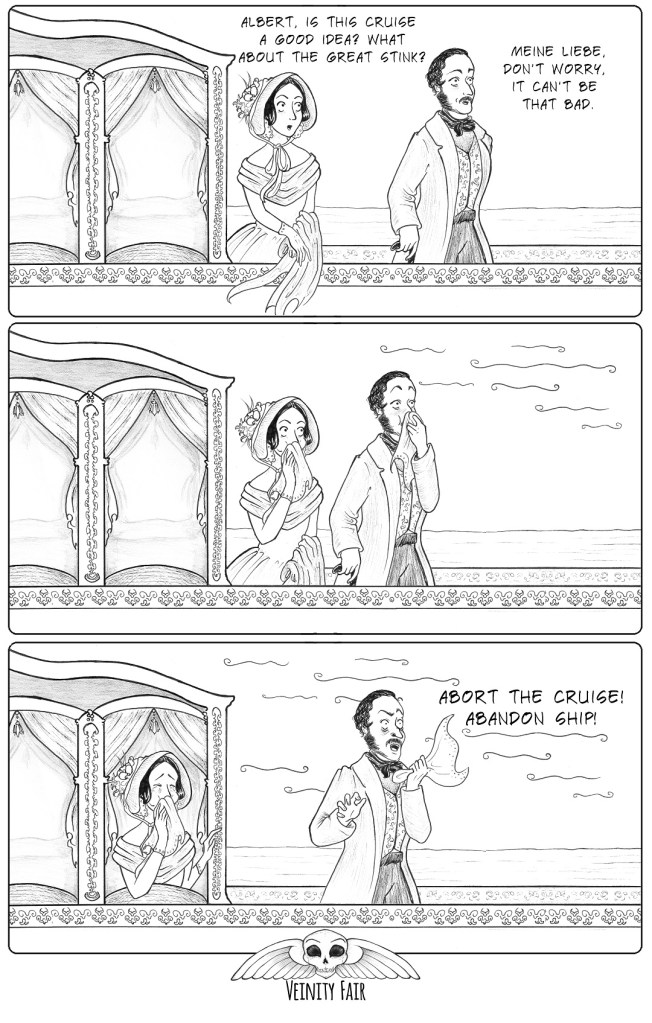
In the summer of 1858, Victoria and Albert took a leisurely cruise down the Thames, unprepared for the severity of the Great Stink. It is said that they lasted on board only a few minutes, despite bringing scented handkerchieves with them. 🙊🙊

If you missed my previous post on the Great Stink itself, check it out! 

Also, here’s an awesome video on the Great Stink

The Great Stink

Epidemiology, Everyday Life, Great Inventions, Medicine

The summer of 1858 was exceptionally hot for Londoners – the temperatures averaged 34–36 °C (93–97 °F) in the shade, reaching even 48 °C (118 °F) in the sun. This unbearable weather was however overshadowed by something even more unbearable: the Great Stink. 🤢

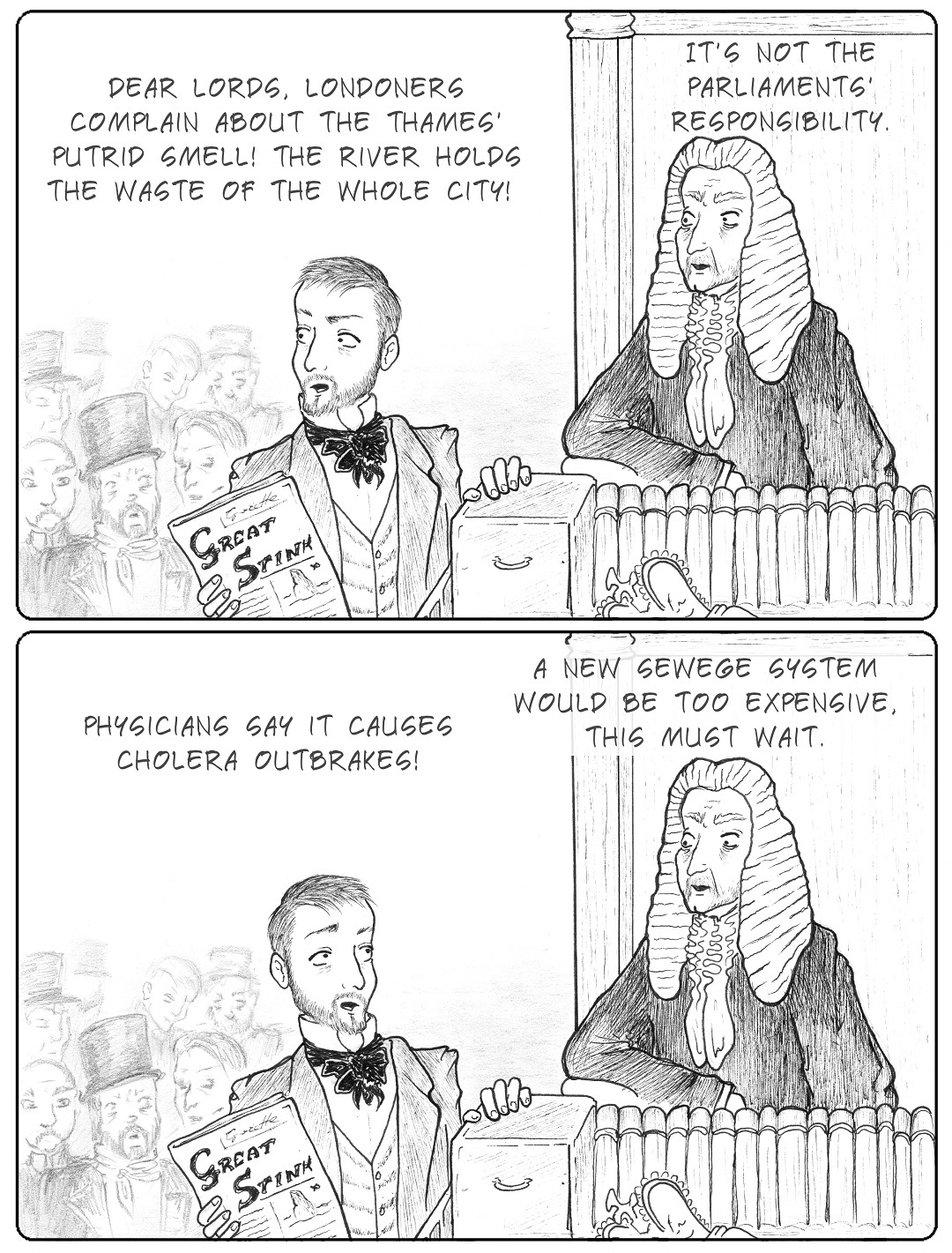
The source of this unbelievable stink was the Thames, which served as a sewer for all human, factory, and slaughterhouse waste in the area. As the London population doubled in the first half of the 19th century, so did the problems surrounding the river that served as the main source of “fresh” water. Apart from the offensive smells, Thames was also the source of cholera outbreaks and other diseases. The situation was dire and many people, including journalists and scientists, urged the government to take appropriate action even before the events of 1858.

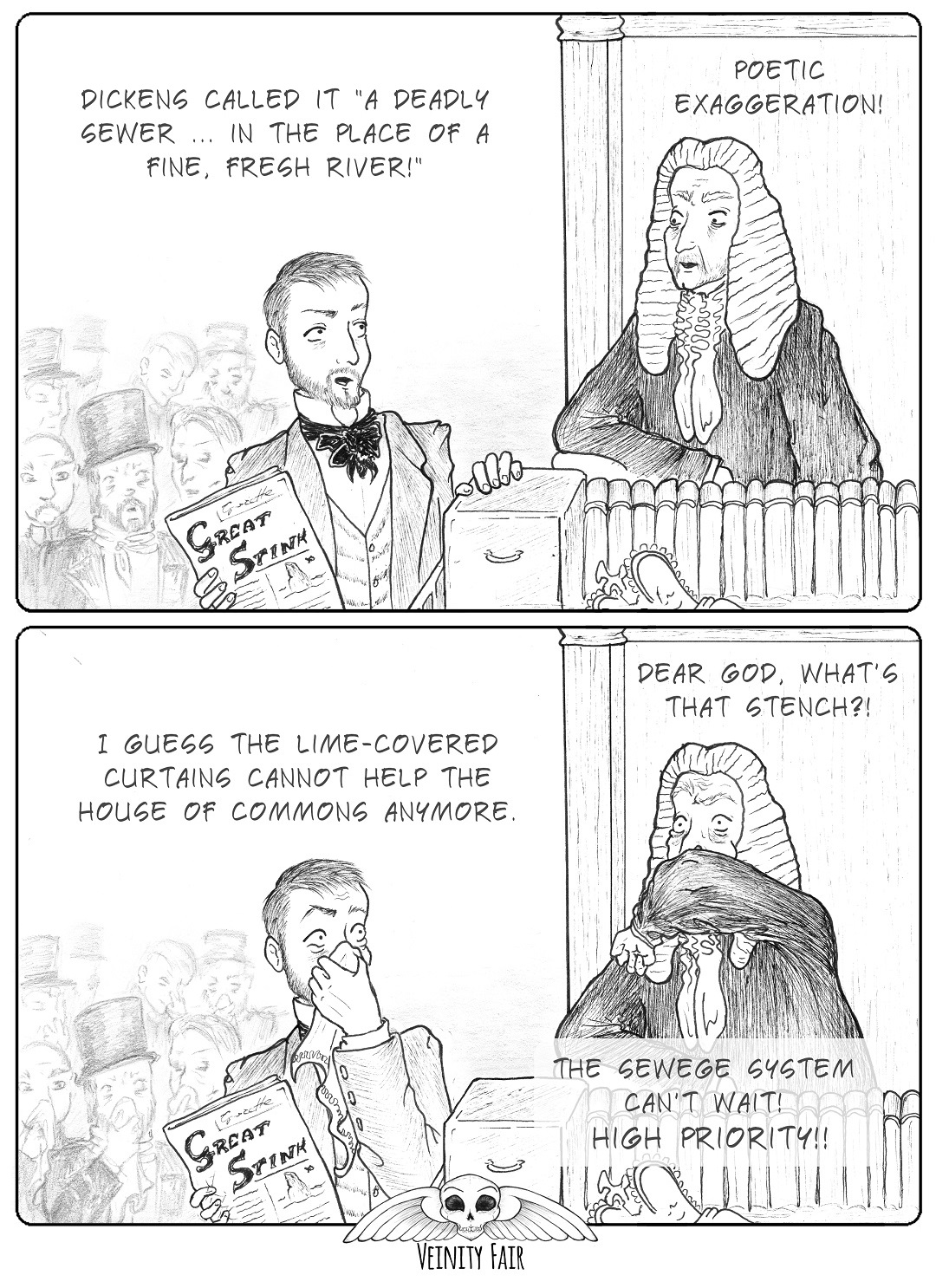
In 1848 the Metropolitan Commission of Sewers was supposed to deal with the problem. A prominent engineer called Joseph Bazalgette created plans for a new sewerage system which was estimated to cost £5.4 million. These plans weren’t accepted by the government, which even suggested that cleaning up the river wasn’t really their problem, even though they had to use scented handkerchiefs, tobacco, and curtains covered with chloride of lime to protect themselves from the putrid smells in the Palace of Westminster. 💩

When the Great Stink of 1858 knocked at the House of Commons’ doors, there was no excuse to postpone dealing with it any longer. As the level of the river dropped because of the heatwave, “a huge pile of human waste was left piled up right next to Parliament.” Benjamin Disraeli described it as a “Stygian pool, reeking with ineffable and intolerable horrors” and proposed a bill supporting the modernization of the sewer system based on the Bazalgette’s plans. 🥰

👻👻👻
This comic was made thanks to Mateusz, who won the possibility of becoming the main character in a local charity event. Thanks! 💜

Don’t forget to check out this awesome video on the Great Stink

Playing Funeral

Entertainment, Everyday Life, Funerals, Home

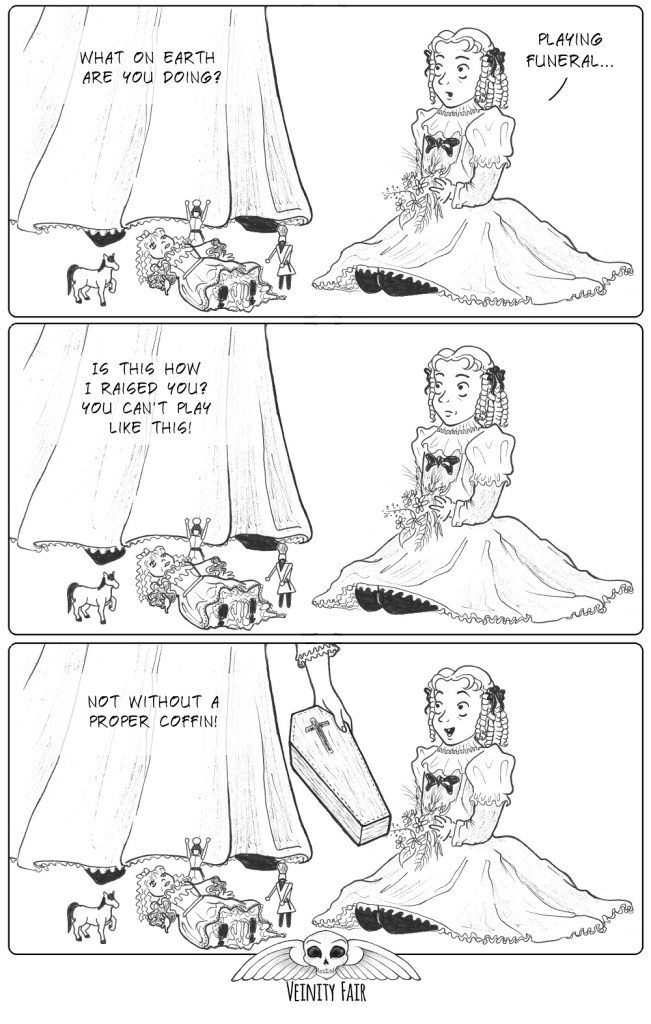
While it might seem morbid today, children playing funeral were not a rare sight in the Victorian era. ⚰️⚰️ It was a reflection of the times – high mortality rate meant that children often witnessed death in their families, not only of grandparents and parents but also siblings.

Special doll sets containing small coffins and mourning fabrics were sometimes given to girls, who would then practice dressing the doll, laying it in the coffin, and performing other tasks connected with a funeral, like attending the mourners.
🧸 ⚰️🧸 ⚰️

Check out this fragment of an “Ask a Mortician” episode for more info (some dolls in the video are a bit disturbing, feel warned).

The Great Book Scare

Epidemiology, Everyday Life, Medicine

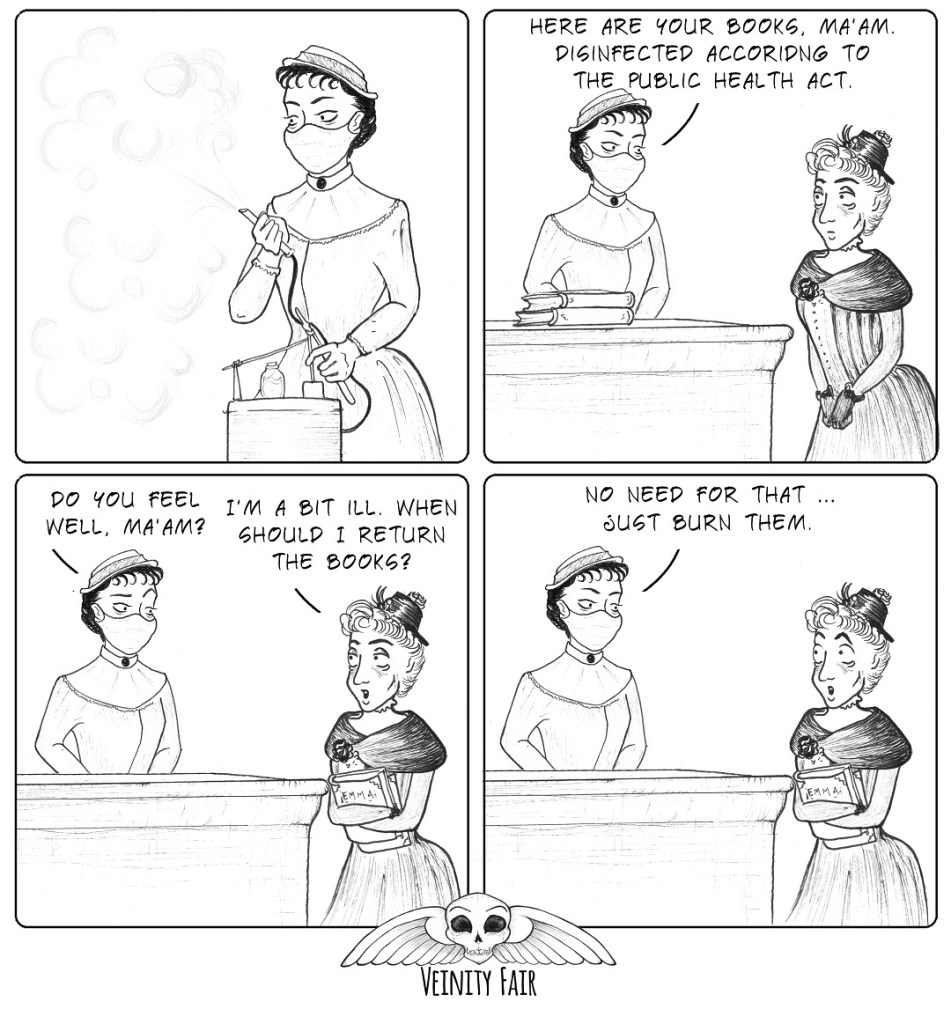
The Great Book Scare was a period between 1880 and 1920 when the general public was obsessed with the idea that library books were a major source of epidemics. 📚😱

Even though the evidence for this was small, especially compared to other potential disease sources, many in the U.S and the U.K. believed that library books could spread everything from tuberculosis to smallpox. 🦠🦠 The authorities and doctors alike started to come up with ideas on how to limit the risk such as treating books with vapors from heated carbolic acid crystals, using formaldehyde, and … just completely destructing books if they had come into contact with a sick person. 😷

Finally, the fear has died out after it turned out that library workers and patrons weren’t really getting sick more often than others. You can read more about these regulations in this article.

Freud and Cocaine

Famous Victorians, Medicine

Sigmund Freud, best known as the father of psychoanalysis, spent a large portion of his life promoting cocaine as a miracle cure for almost everything. Not only did he prescribe cocaine to his patients, but also used it himself on a regular basis. Some scholars believe this has largely influenced his theories on the human psyche and treatments which are considered pseudoscientific today.

Flying Wombs

Everyday Life

The advent of the steam-powered locomotive 🚂 allowed people to travel farther and faster than ever before, and quickly became popular with the public. However, the freedom which came with this form of transport was also seen as a moral and physical threat, especially to women. 😲

Some believed that “vulnerable” women’s bodies wouldn’t handle the high-speed (80 km/h or 50 mph) travels, resulting in faintings, madness, or … uteruses falling out. ☠️ Therefore women were sometimes discouraged from traveling.

This myth, like many other myths at the time, reflected the fear of women becoming more independent, mobile, and not as fragile as the Victorian society wanted them to be. 🦸‍♀️

Find out more about this strange belief in this Mental Floss article.

Arsenic Routine

Cosmetics, Everyday Life, Medicine

Many Victorians wanted to have a very pale complexion which was supposed to give them a more aristocratic look. 👻 Because of that, companies started to add arsenic to various cosmetics, including soaps 🧼, lotions, 🧴 and powders . Arsenic was also advised, either in the form of wafers 🍬( e.g. Dr Rose’s Arsenic Complexion Wafers) or fluids 🥛 (e.g. Fowler’s Solution, also used as medicine).

There were known cases of death caused by such treatments, but it didn’t discourage many of the customers. ☠️

Interestingly, prolonged use of arsenic actually darkens the skin, which suggests that the producers might have skimped on the arsenic quantity in their products, thus making them a little bit less deadly.

You can find more crazy treatments from the past in a fascinating book: Quackery: A Brief History of the Worst Ways to Cure Everything.